Choosing aquatic plants involves matching species requirements to the conditions already present in a tank — or adjusting conditions to accommodate a desired plant. Light intensity, substrate depth, water hardness, and CO₂ availability each influence which species will establish successfully and which will slowly deteriorate.
The species described below represent a cross-section of what is commonly available in Poland through aquarium shops and online suppliers. They range from low-maintenance background plants to more demanding foreground species, allowing a range of setups from simple low-tech arrangements to full CO₂-injected planted tanks.

Background Plants
Vallisneria spiralis
Vallisneria spiralis is a grass-like plant native to tropical and subtropical regions, now extensively cultivated for aquarium use. Its long, ribbon-shaped leaves grow vertically and can reach the water surface in tanks 40 cm or deeper, creating a backdrop that also breaks line-of-sight for timid fish species.
Vallisneria spiralis — Parameters
- Temperature: 15–30 °C (adaptable to unheated tanks in summer)
- pH: 6.5–8.5 (prefers harder, alkaline water)
- Light: Moderate — does not require CO₂
- Substrate: Fine to medium gravel or sand, nutrient-rich preferred
- Propagation: Runners — separates naturally into daughter plants
In Poland, Vallisneria performs particularly well in tap water supplied from limestone-rich areas — such as parts of Małopolska and Śląsk — where water hardness (GH) tends to be higher. It tolerates lower temperatures than most tropical plants, making it a reasonable choice for tanks without heating.
Echinodorus bleheri (Amazon Sword)
Echinodorus bleheri, the Amazon sword, is a rosette plant reaching 30–50 cm in height. It produces broad, lance-shaped leaves from a central crown and requires a nutrient-rich substrate since it feeds primarily through its root system. Root tabs placed near its crown at three-month intervals are a standard maintenance approach.
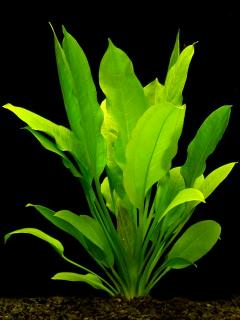
Because of its size, Amazon sword functions better as a centrepiece or corner plant in tanks of 100 litres or more. In smaller tanks, its footprint dominates the available planting space. Moderate to high lighting encourages compact growth; under insufficient light, the leaves elongate and lose their characteristic mid-green colour.
Mid-Ground Plants
Anubias barteri var. nana
Anubias nana is a rhizome plant that attaches to hardscape materials — driftwood and rock — rather than rooting into substrate. Its thick, dark-green leaves are among the most durable of any commonly kept aquarium plant, resisting damage from herbivorous fish such as goldfish and some cichlid species.
Anubias nana — Parameters
- Temperature: 22–28 °C
- pH: 6.0–7.5
- Light: Low to medium — very high light encourages algae on leaves
- Placement: Rhizome must remain above substrate; attach to hardscape
- CO₂: Not required
- Growth rate: Slow (1–2 leaves per month under normal conditions)
Anubias nana is susceptible to algae growth on its leaves when light intensity is high, because the plant grows too slowly to outcompete algae for nutrients at the leaf surface. Positioning it in a shaded area of the tank, or under floating plants that diffuse light, reduces this problem significantly.
Microsorum pteropus (Java Fern)
Java fern is another rhizome plant from Southeast Asia, widely distributed in the aquarium trade. Unlike Anubias, it produces new plantlets directly on the surface of mature leaves — a reproductive strategy that makes vegetative propagation straightforward. Once a plantlet develops several roots, it can be detached and attached to a new surface.
Java fern tolerates a broad range of water parameters, making it one of the more forgiving species available. It grows slowly in low light but remains healthy without showing the yellowing or leaf melt that affects softer-leaved plants in suboptimal conditions.
Foreground Plants
Foreground plants — those growing at or near the substrate surface — are generally the most demanding in terms of light, CO₂, and nutrient availability. In tanks without CO₂ injection, options are limited but exist.
Sagittaria subulata
Sagittaria subulata is a short grass-like plant that stays compact under bright light and spreads via runners to form a carpet-like effect over time. It tolerates a wider pH range than many carpet plants and does not strictly require CO₂ injection, though growth is faster with supplementation. Polish tap water in most regions suits it well.
Eleocharis acicularis (Dwarf Hairgrass)
Dwarf hairgrass produces very fine, needle-like leaves and forms a dense lawn in well-lit, CO₂-supplemented tanks. Without CO₂, growth is minimal and the plant tends to produce sparse, upright clumps rather than a true carpet. It is included here because it is frequently sold in Polish aquarium shops and the requirements are often underrepresented on packaging.
Plant Placement Strategy
The standard aquascape layout places taller plants at the rear, mid-height species in the middle, and carpet or small foreground plants at the front. This arrangement creates depth and ensures taller plants do not shade shorter ones. However, contrast in leaf shape and texture — mixing broad Echinodorus leaves against fine Vallisneria blades, for instance — typically produces more visually coherent results than varying height alone.
Internal references: Aquarium Setup Guide covers substrate selection and lighting in detail. Freshwater Fish Care describes which species coexist with planted tanks without disrupting plant roots or grazing on leaves.
Species data referenced against FishBase and Tropica plant database. Last updated 4 June 2026.